How to help your child improve in Chinese (even when you don't speak it and enrichment classes are already piling up)
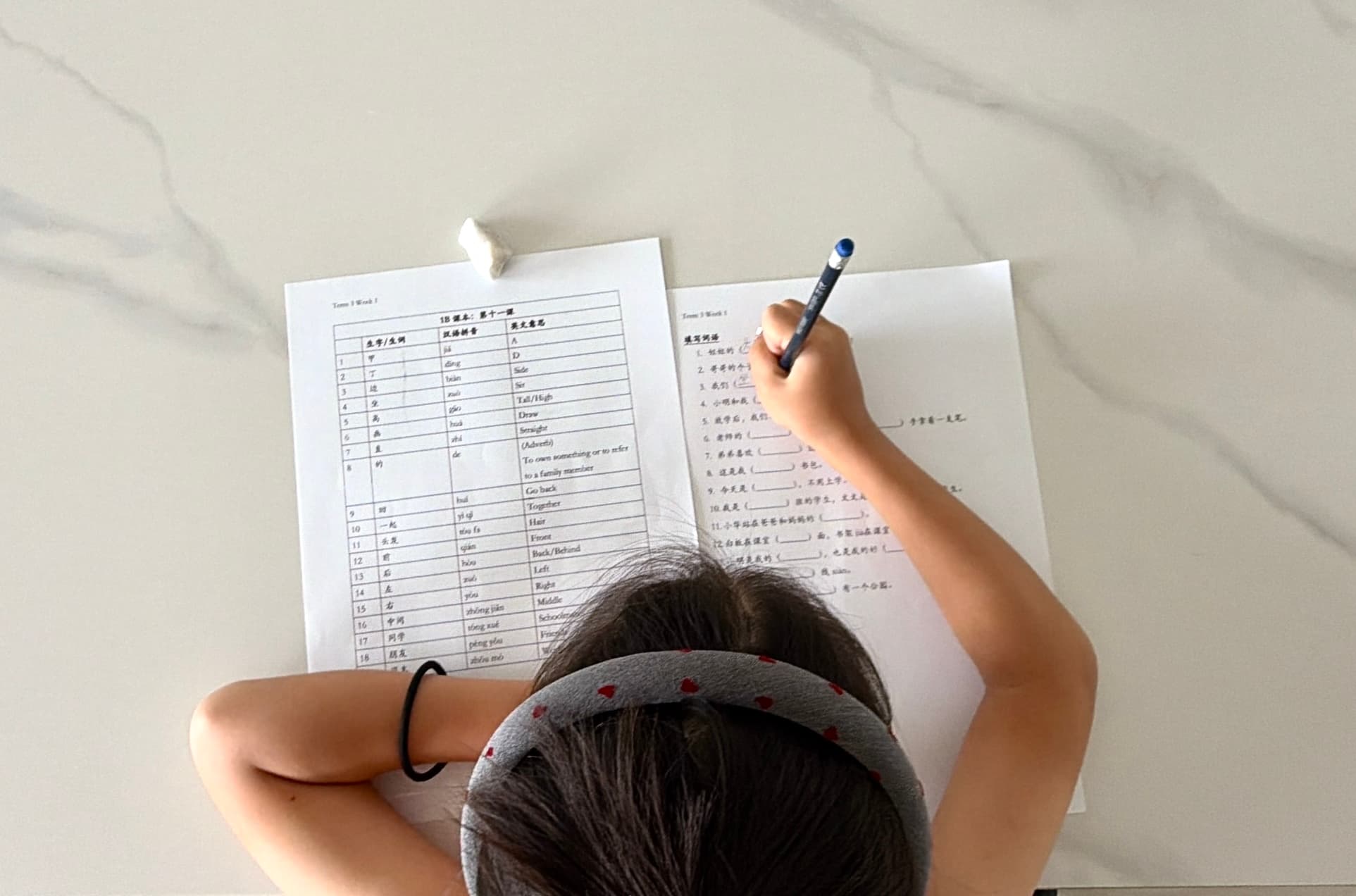
Chinese is the subject that stresses most Singapore parents out with the main reason because everyone speaks English at home - the kids are more comfortable in English, and honestly... so are you.
Maybe you have already signed them up for a Chinese enrichment class or private tutor once a week. And yet you still worry. Is my child keeping up? Is one class a week really enough when we barely speak Chinese at home?
You know deep down that adding yet another class, another time slot to coordinate, is just not realistic right now, because there are also other enrichment classes in the picture and your child's schedule is already packed (piano, math, swimming, you name it).
If this sounds like you, this article is for you.
Going for Chinese enrichment is a great start. But it is usually not enough.
Here is the honest truth. One Chinese enrichment class a week, on its own, is rarely sufficient for English dominant kids, especially when Chinese is not part of daily life at home.
Enrichment classes are genuinely valuable. They keep your child in contact with the language and help them stay aligned with what the school is covering. But for kids who go straight back to English the moment they walk out of class, a lot of what was covered starts to fade before the next session comes around.
Research confirms this. A classroom study by Goossens et al. (2012) found that children who practised vocabulary across multiple short sessions through the week remembered significantly more than those who covered the same content in one sitting. A 2016 meta-analysis by Kang, reviewing over 250 studies, showed that spaced practice consistently produces better long-term retention than massed practice.
What this means practically is that your child needs regular, consistent contact with Chinese between their enrichment sessions. Not more hours, not another class, but short, structured supplementary practice a few times a week.
The solution
And that is exactly what the Chinese study and revision routine on Toshi was built for.
It is not just some worksheet or a drilling exercise, but a supplementary learning solution created by a teacher who genuinely understands how these children think, who can bridge English and Chinese, and who makes the learning feel accessible rather than overwhelming.
林老师 ("Lin Lao Shi") is an ex-MOE teacher with more than 15 years of experience, and her specialisation is helping English dominant children build real understanding in Chinese. What sets her apart is that she does not just go through the answers. She shares tips and memory tricks to help vocabulary stick, explains the logic behind the language, and teaches in a way that is warm, engaging and nothing like the rote repetition many kids dread.
How the Chinese study and revision routine on Toshi works
Each session takes 30 to 45 minutes. No travel, no coordinating with a tuition centre. You set it up once and it recurs in your family calendar automatically every week.
And it is designed upon a simple 3A framework:
Step 1: Acquire - Vocabulary list
Your child reads through the week's vocabulary before starting the worksheet. Each word is shown with the Chinese character, Hanyu Pinyin and English meaning side by side. Sessions are designed to align with the MOE school syllabus, so parents can rest assured their child is always revising what they need to know for school.
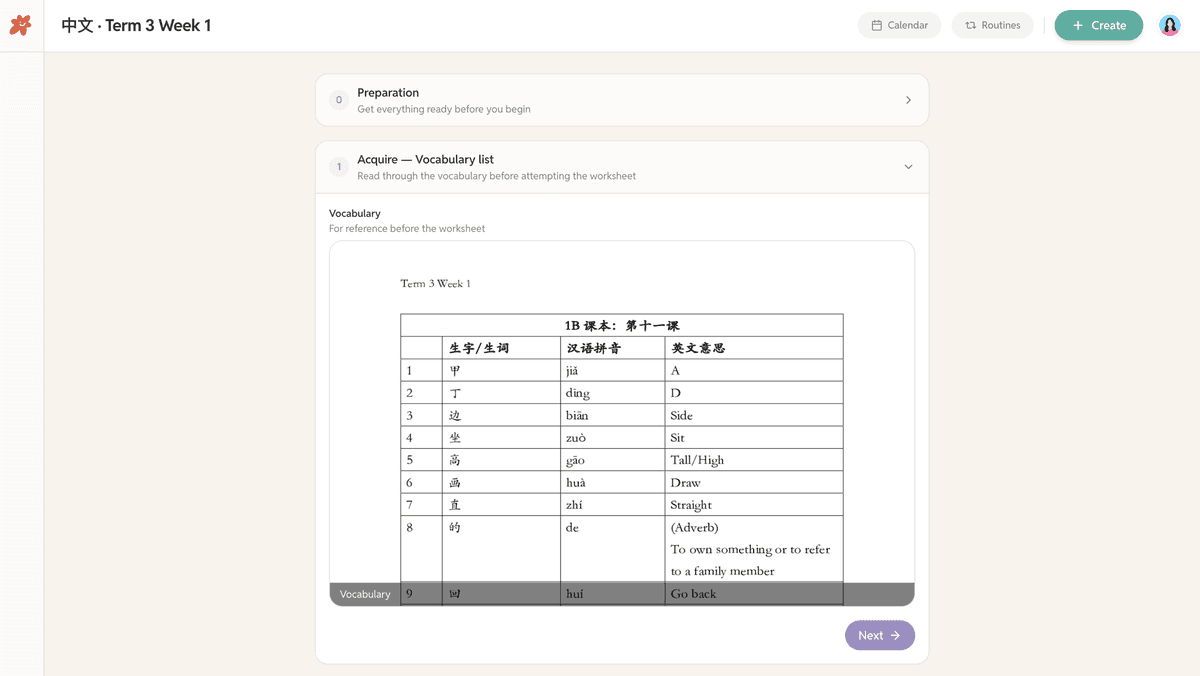
Step 2: Apply - Complete the worksheet
Your child completes the practice worksheet independently. Fill in the blank sentences, picture to word matching. Once done, you mark it together using the answer key — a simple, low-pressure way to see exactly where more practice is needed.
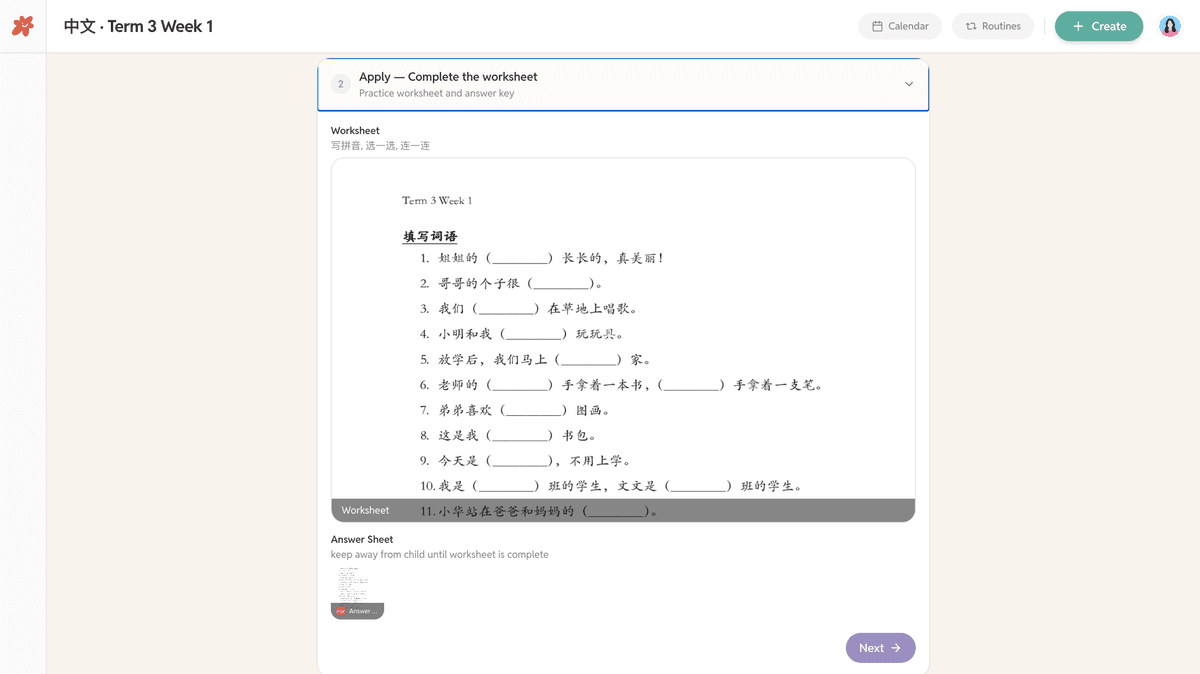
Step 3: Analyse — teacher explanation video (Chinese Revision Plus)
Available with the upgraded version, 林老师 walks through every answer on the worksheet, sharing tips and memory tricks to help the vocabulary stick. Engaging, practical and nothing like rote learning.
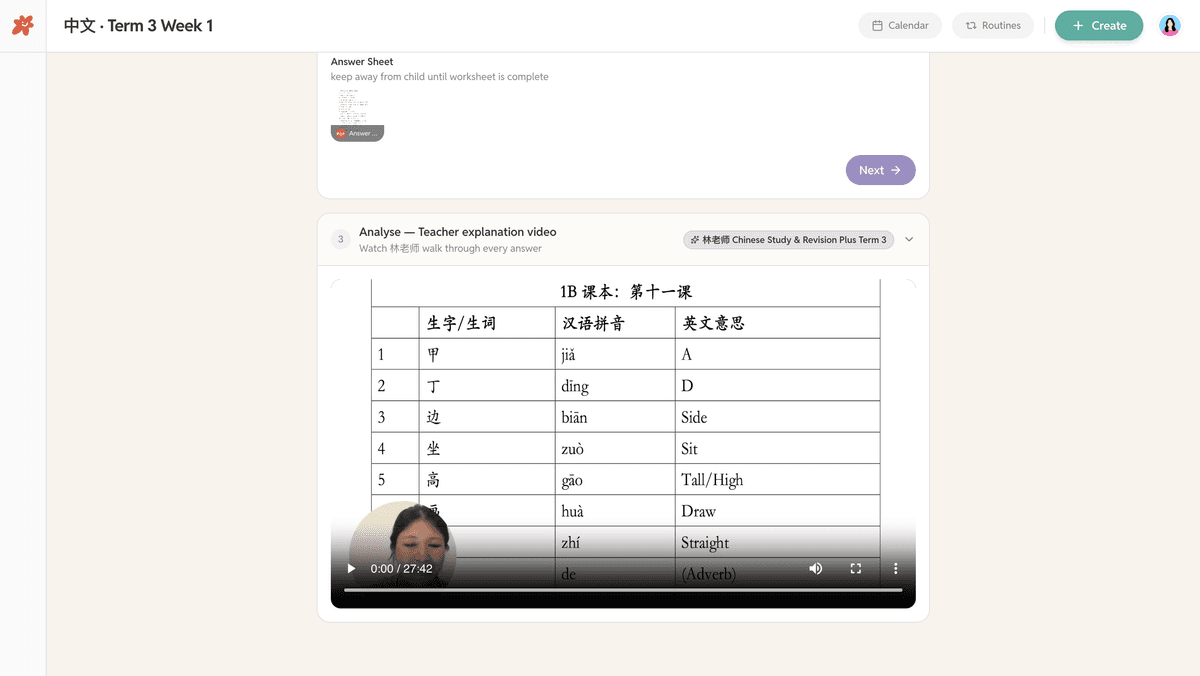
Want to get a glimpse of 林老师 in action? Watch the video below.
Free version: vocabulary list + practice worksheet, aligned to the MOE school syllabus. Chinese Revision Plus: everything in the free version, plus 林老师's full explanation video for every week's worksheet and practice.
Note: As of July 2026, the Chinese study and revision routine is only available for Primary 1 students. We are working hard to build content for the other levels, so if your child is in a higher primary year, watch this space.
Head to heytoshi.com to sign up and get started!
References
Goossens, N. A. M. C., Camp, G., Verkoeijen, P. P. J. L., Tabbers, H. K., & Zwaan, R. A. (2012). Distributed practice and retrieval practice in primary school vocabulary learning: A multi-classroom study. Applied Cognitive Psychology, 26(4), 523–531. https://doi.org/10.1002/acp.2830
Kang, S. H. K. (2016). Spaced repetition promotes efficient and effective learning. Policy Insights from the Behavioral and Brain Sciences, 3(1), 12–19. https://doi.org/10.1177/2372732215624708