How to help your child with spelling tests at home
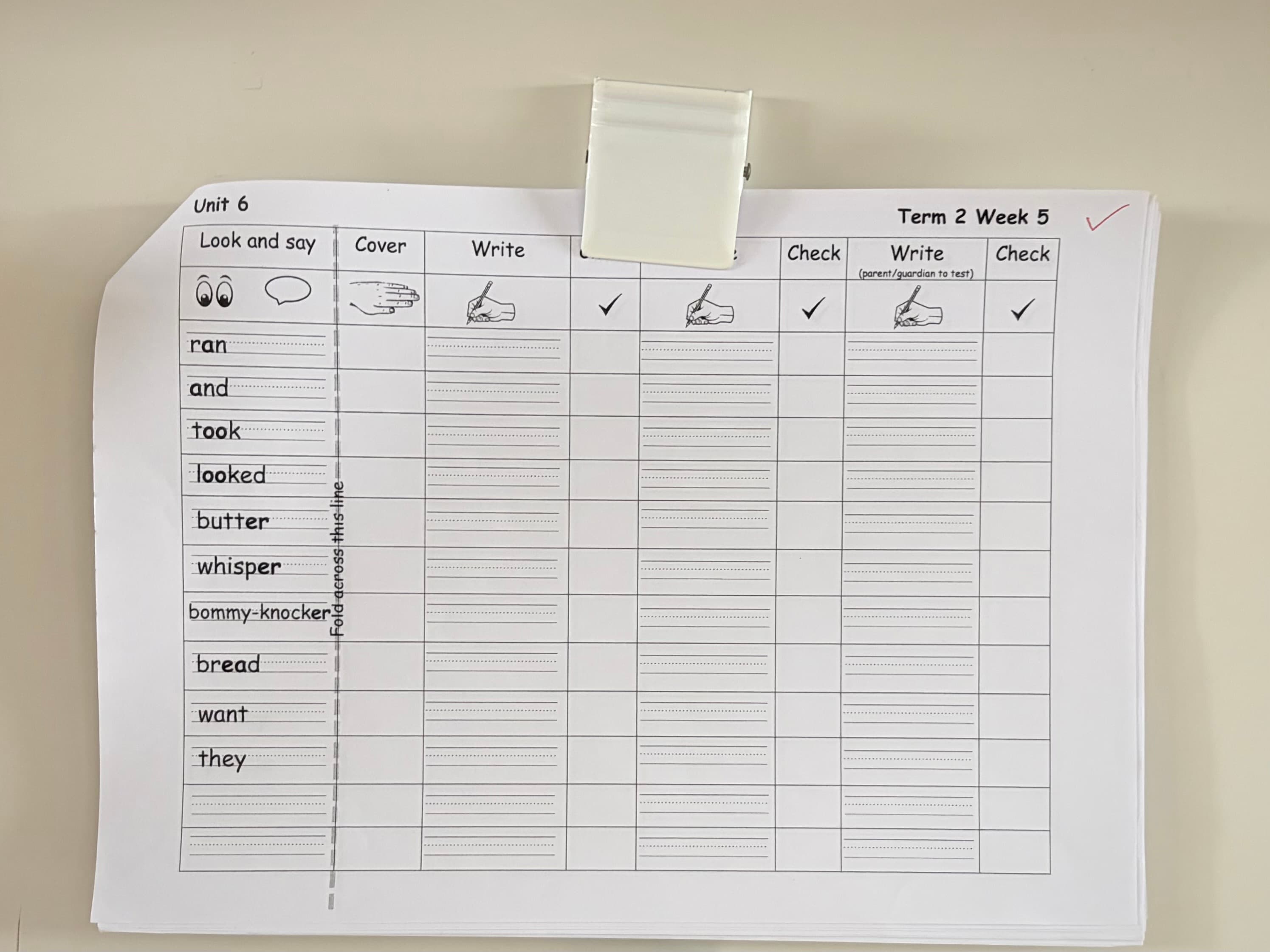
Spelling practice at home is one of those things that sounds simple but can quickly become a source of stress for the whole family. The word list comes home, the week fills up, and before you know it, it is the night before the test and everyone is tired and a little bit frantic.
If you have a primary school aged child in Singapore, this probably sounds familiar. The good news is that helping your child prepare for spelling tests does not have to be complicated or time-consuming. With the right approach, it can actually become one of the easier parts of the school week.
Why your child keeps forgetting how to spell after practicing
The most common reason is not a lack of effort. It is the timing.
Many families do most of their spelling practice in one sitting, the night before the test. This is called massed practice, and while it might feel productive in the moment, the brain does not retain information well this way. Research consistently shows that spreading practice across multiple shorter sessions leads to far better long-term retention than cramming it all into one go [1]. This is called spaced repetition, and it has been demonstrated to make a meaningful difference specifically for young children's memory and learning [2].
The shift is simple: shorter sessions spread across the week will do more for your child than one long stressful session the night before the test.
1. Test your child first to find the words that actually need work
Before you start drilling the entire word list, take five minutes to find out which words your child already knows and which ones they genuinely struggle with.
Say each word out loud and let them try to spell it. Note the ones they get wrong or hesitate on. Those are the words that need the most practice time. The ones they already know just need an occasional revisit to stay fresh. This approach saves time, keeps frustration low, and makes the practice feel manageable rather than overwhelming.
2. Use Look, Cover, Write, Check instead of copying
This is one of the most widely recommended spelling practice methods for primary school children, and there is good research to back it up.
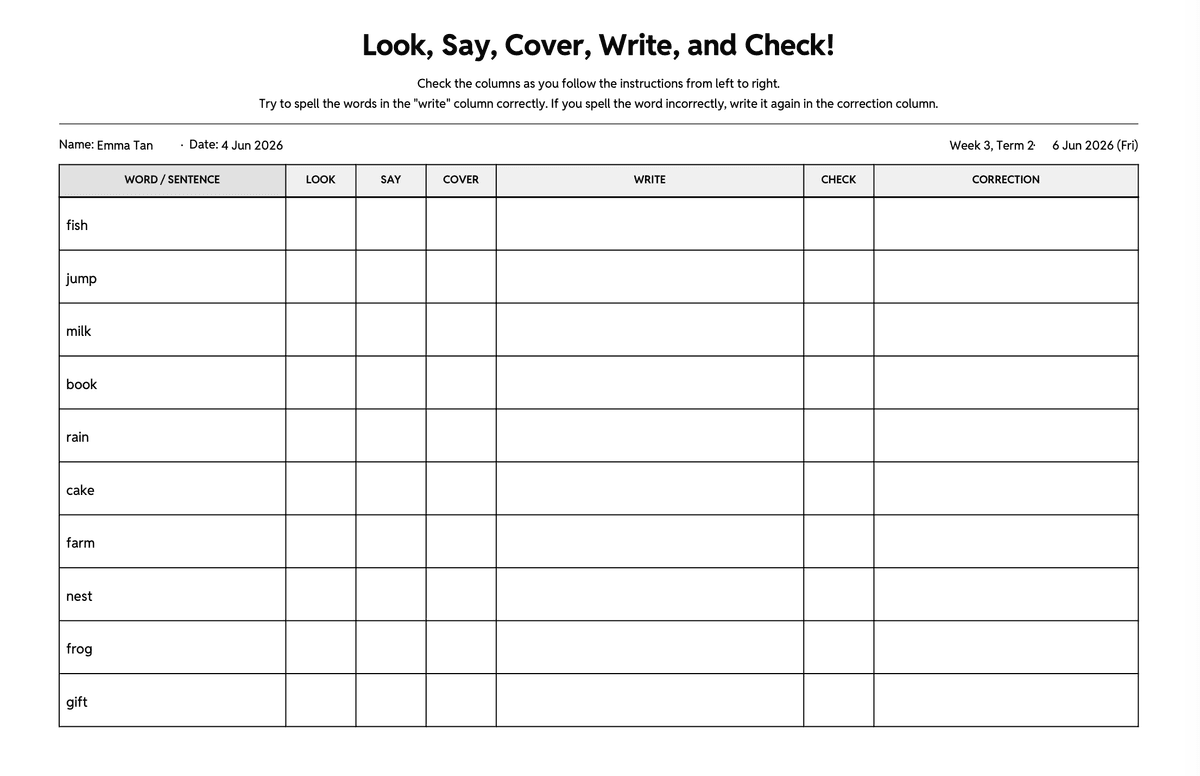
Here is how it works:
Look at the word carefully
Cover it
Write it from memory
Check if it is correct
A study published in the Australian Journal of Learning Difficulties found that this retrieval-based approach leads to better learning of spelling words compared to passive methods like copying [3]. The covering step is what makes it work. By removing the word from sight, the child has to actively retrieve the spelling from memory, which is where real learning happens.
It is also worth noting that this method works even better when paired with an understanding of why a word is spelled a certain way, not just what the letters are [4]. Where you can, help your child see the pattern or rule behind a word. That kind of deeper understanding tends to stick.
3. Find a practice rhythm that works for your family
When it comes to spelling practice at home, consistency matters more than the length of each session.
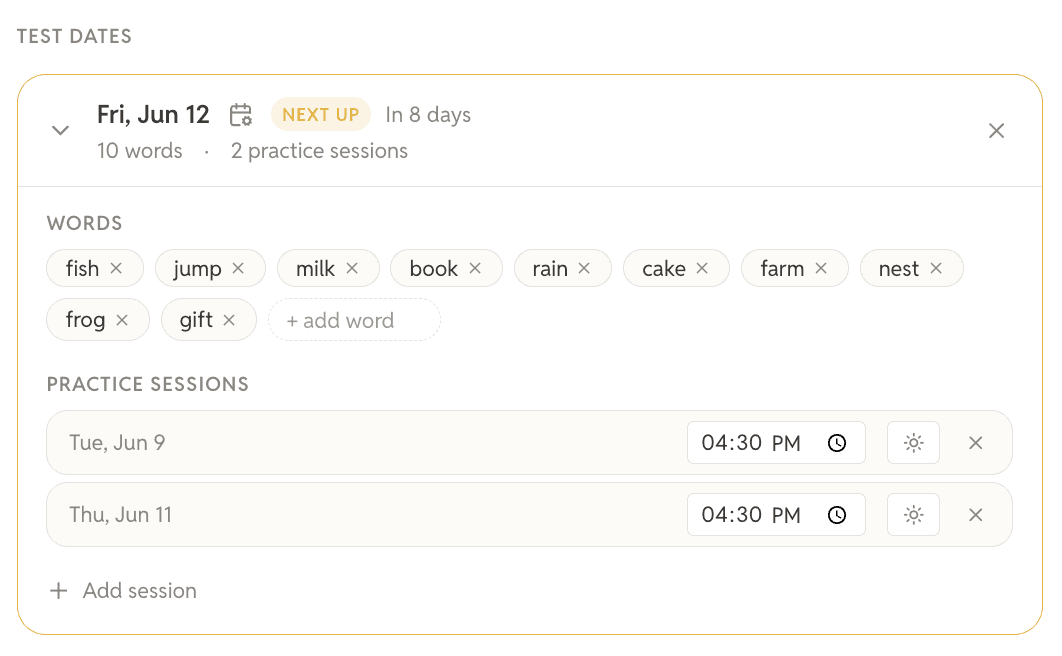
How often your child needs to practise will depend on how many difficult words are in their current list and how quickly they tend to pick things up. Some children need more repetition, others get it in a couple of rounds. Rather than aiming for a rigid daily schedule that adds pressure to an already full week, find a rhythm that you can both actually keep up with.
One practical way to make this easier is to attach practice to something that already happens. Right after the school snack. Before screen time. After dinner and before bath. A habit that slots in alongside an existing routine is far easier to maintain than one that requires building from scratch every day.
4. Let your child mark their own mistakes
This one small change can make a big difference to how much your child actually learns from each practice session.
After a practice spelling test at home, instead of correcting their work for them, hand it back and let them check their own answers against the word list. When a child marks their own mistake, they are forced to look at the correct spelling directly alongside their error. That comparison is much more memorable than simply being told the right answer. It also builds the habit of self-checking, which is exactly what they will need to do independently during the real test.
5. For busy parents: How to make spelling practice happen even when you cannot be there
This is perhaps the most honest part of helping your child with spelling tests at home. The practice works best when it is consistent. But consistency is genuinely hard when you are juggling work, the household, and everything else that comes with family life.
The traditional model of spelling practice requires an adult to sit with the child, read out each word, wait for the response, and check the answer. On many evenings, that just is not realistic. And yet, the practice still needs to happen.
This is exactly what the Spelling Practice Routine in Toshi was built for.
Here is how it works:
Parents sets up the spelling list in Toshi and decides the practice sessions.
When it is time to practise, parents can use Toshi to generate the practice worksheets for the child to practice before testing their spelling words.
The child opens the routine and listens to each word through the app, and writes each word down on paper as they go.
Parent does not need to be present for the entire session. They can press play and step away to handle other things while the child works through it independently.
When the session is done, the child marks their own answers, or parent comes back and marks together.
If the parent is at work, a helper or supervising adult can sit with the child instead. Once the session is complete, they take a photo of the finished practice sheet to record it as done, and the parent gets notified.
Watch the video below to see exactly how the Toshi Spelling Routine works in real life.
It is not about replacing the time you spend with your child. It is about making sure the practice still happens on the nights when life gets in the way.
Set up your child's first spelling practice routine at heytoshi.com
References
[1] Kang, S.H.K. (2016). Spaced Repetition Promotes Efficient and Effective Learning. Policy Insights from the Behavioral and Brain Sciences, 3(1), 12–19. https://journals.sagepub.com/doi/abs/10.1177/2372732215624708
[2] Vlach, H.A., Bredemann, C.A., & Kraft, C. (2019). To mass or space? Young children do not possess adults' incorrect biases about spaced learning. Journal of Experimental Child Psychology, 183, 115–133. https://doi.org/10.1016/j.jecp.2019.02.003
[3] Kohnen, S., Nickels, L., & Castles, A. (2017). To what extent does children's spelling improve as a result of learning words with the look, say, cover, write, check, fix strategy compared with phonological spelling strategies? Australian Journal of Learning Difficulties, 22(1). https://www.researchgate.net/publication/321087057
[4] Esposito, L. et al. (2023). Capturing variations in how spelling is taught in primary school classrooms in England. British Educational Research Journal. https://bera-journals.onlinelibrary.wiley.com/doi/10.1002/berj.3829