How to revise for PSLE Chinese in the last 30 days
If your child is sitting Primary School Leaving Examinations (PSLE) this year, you are probably somewhere between "we still have time" and full panic mode.
And when we panic, we tend to add. Another practice paper, another tuition slot, another hour of revision after dinner. It feels like the least we could do for our kids, but I am not sure it always is.
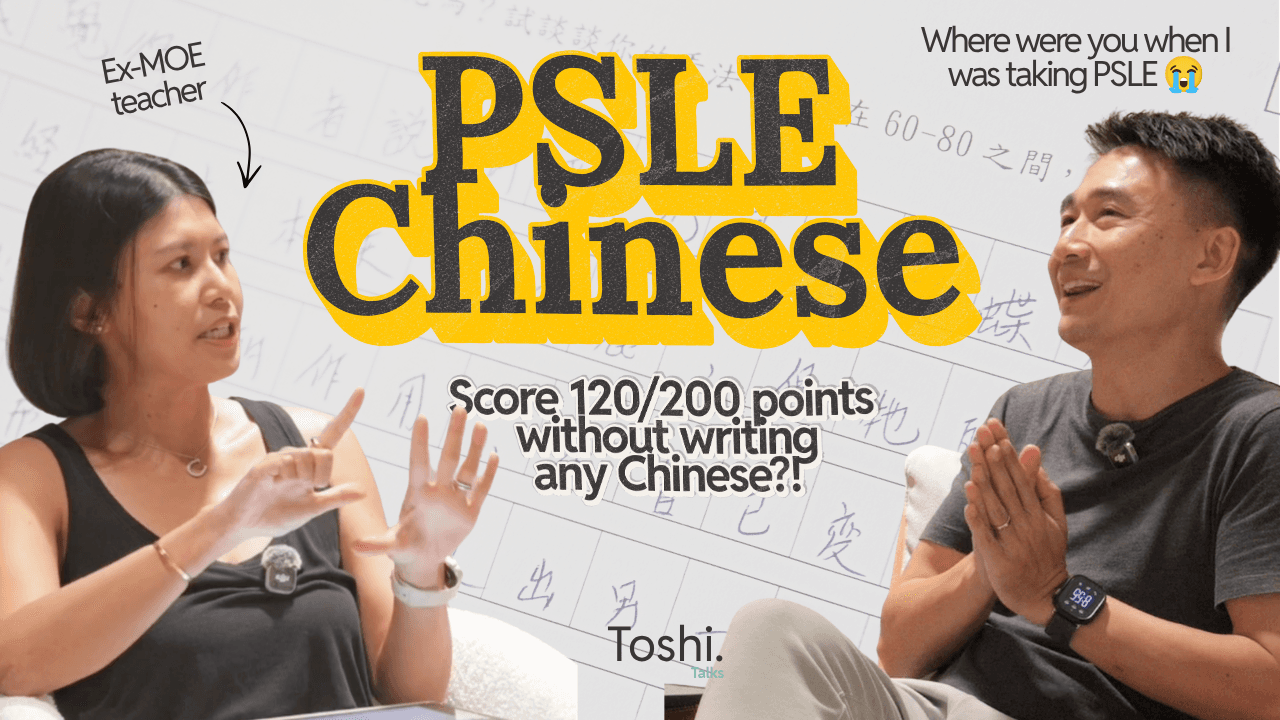
So for Episode 4 of Toshi Talks, we sat down with Alynna, 林老师, to talk about how parents and students can prepare effectively for the upcoming PSLE. She is an ex-MOE Chinese teacher with more than 16 years of experience, and most of her students are the English dominant kids, the ones who go straight back to English the moment they walk out of class.
And her very first piece of advice had nothing to do with studying at all: Don't eat rubbish.
Very common sense, I know, but she says it to every single cohort and it is still worth saying here. You cannot make magic happen in 30 days, but you can definitely avoid an accident. She has seen a child prepare properly for nine months and then fall sick on the paper day, and there is no revision plan in the world that fixes that. So keep them well, keep them sleeping, and be a bit extra careful about food for the next few weeks.
With that out of the way, here is the actually useful part. 😊
First, know where the marks are
PSLE Chinese is out of 200 marks, and here is roughly how it splits:
Paper 1
Composition Writing: 40 marks
Paper 2
Reading Comprehension Booklet A (MCQ): 50 marks
Reading Comprehension Booklet B (MCQ + Open-ended): 40 marks
Paper 3
Oral Communication: 50 marks
Listening Comprehension: 20 marks
For students who are weaker in Chinese, Alynna suggests that they focus on Booklet A of paper 2, oral examination and listening comprehension, as they can get 120 out of 200 marks without writing a single Chinese character.
Instead of focusing on the harder aspects, which are usually 作文 (composition) or 理解问答 (comprehension), she would go the other way and point them at where the marks actually sit, and where they are least resistant.
For the last 30 days: How to revise
1. Leave alone what they are already good at
If your child is already solid in something, park it until the last two weeks, because they are not going to suddenly forget how to do it. Put the time into the weaker links instead, since that is where the movement is.
2. Drill MCQ, because that is where the repetition lives
For a child who is weaker in Chinese, MCQ is the highest return practice there is. The vocabulary and question types genuinely repeat across papers, so the more they see, the more they start recognising questions on sight. 理解问答 passages almost never repeat the same way, so drilling those for volume gives you far less back.
3. For comprehension, drill the first and last questions
This one is very specific and very useful. Rather than grinding through whole comprehension papers, she drills the first question and the last one, which are the inference and meaning questions, because those are the ones that keep reappearing across different passages. The middle questions tend to be passage specific, so they teach your child less.
4. Break it up, and always retest the wrong ones
Nobody should be sitting down to 200 MCQ questions in one go, and honestly most adults could not do that either. Do maybe 20 questions, take a proper break, then come back.
Also, take everything they got wrong and test them on those same questions again. This is the part most of us skip, because marking feels like the end of the exercise, when really, the retest is the exercise.
5. Resist the urge to add more tuition now
We asked her this directly, because we assumed more practice would mean more retention.
But she said no, and quite firmly. In this situation, more is not merrier, and at this stage she thinks it backfires, because if your child already dislikes the subject and you are now adding more of the thing they dislike, this resentment will grow and will not produce results.
There's also one more thing to note. There are also three other subjects sitting there. Unless your child is comfortably fine in English, Math and Science, pouring seven days a week into Chinese is really just borrowing time from somewhere else.
In summary, less is more
When we are anxious, we add. And the honest version of this last month leading up to PSLE is that most of the high value moves are actually subtraction: fewer questions done properly, better rest and nutrition, and marks taken from where they are genuinely sitting rather than where we assume they should be, especially for students who don't have a strong command of the Chinese language.
Simple, but not easy. If your child is sitting PSLE this year, I hope something in here is useful.
加油! You have both got this. 💛
Alynna shared more exam preparation tips int he episode itself. Watch the full conversation on the Toshi Talks YouTube channel.
Written by Rae, co-founder of Toshi