The best way to help your child practice 听写 (Ting Xie, Chinese Spelling) - Even if you cannot read Chinese
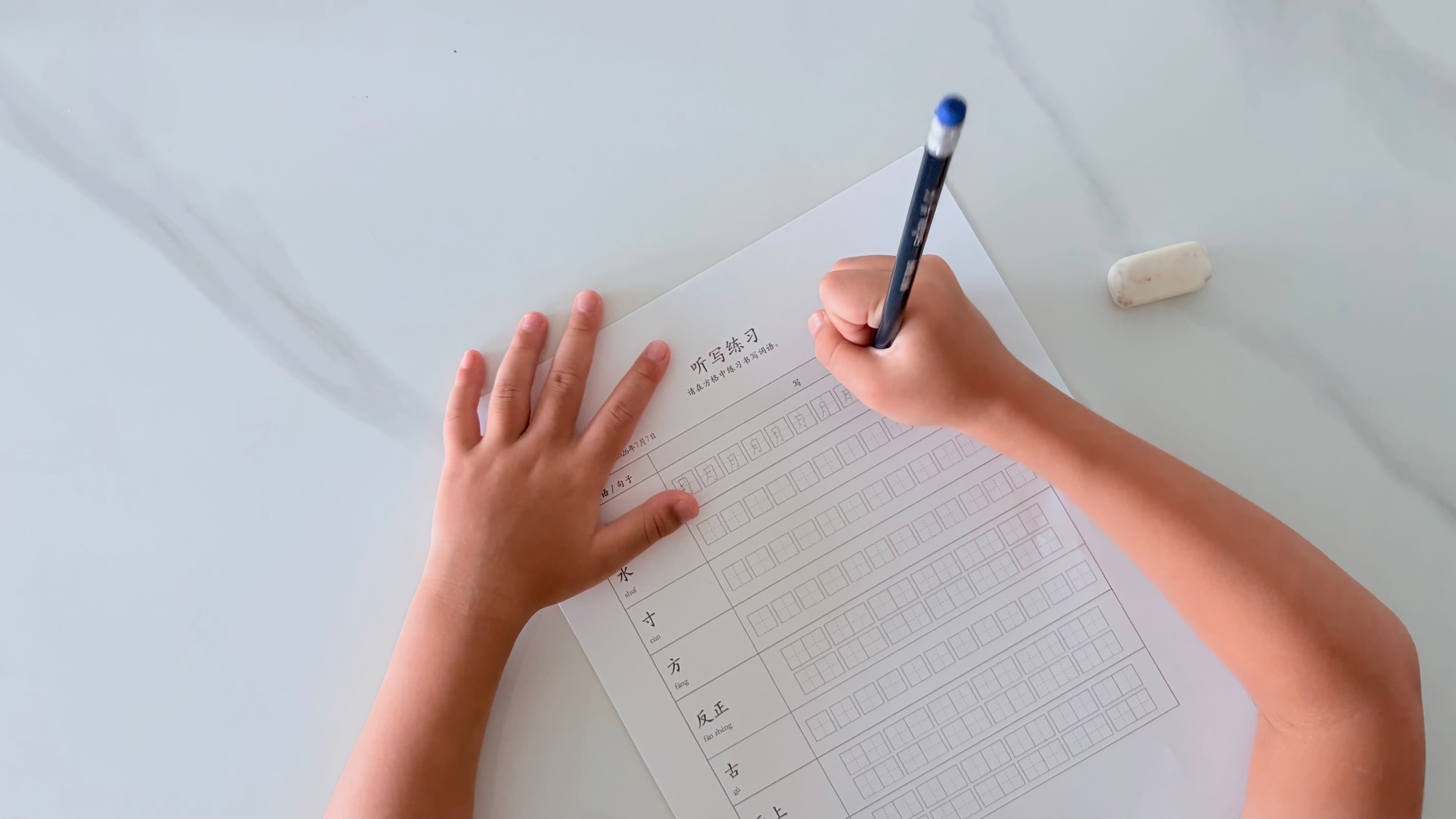
At the start of every school term, a 听写 ("ting xie") word list comes home. It might stay in the bag, maybe onto the fridge, and then the weeks go by. Before you know it, the spelling test is this Thursday and your child hasn't practised for it. If you cannot read Chinese, the stress doubles. Because even if you wanted to help, you are not sure how.
The good news is that you do not need to be fluent in Chinese to help your child prepare well for 听写. You just need a method that does not rely on you being able to read every character on the list.
Here is what actually works - and how our own children have managed to do well for every test.
Why it is harder to help with 听写 than with English Spelling
With English spelling, most parents can sound a word out, check an answer, or at least have a go. Chinese 听写 is different. The traditional method requires someone to read each character aloud, in the correct tone, while your child listens and writes. If that person is not available, or cannot read the characters, the practice simply cannot happen the usual way.
This is why so many families end up in the same position every week: good intentions, not enough time, and a child walking into the test underprepared.
These three things below fix that, even if your understanding of Chinese is nonexistent.
1. Practice consistently, not just the night before
The week your child has a 听写 test, try to fit in two or three short practice sessions rather than one long one. This has nothing to do with whether you speak Chinese — it is simply how memory works.
Research consistently shows that spreading practice across shorter sessions leads to much better retention than cramming everything into a single last minute revision [1]. This applies directly to young children learning to write characters. The brain needs time between sessions to consolidate what it has learnt [2].
Two or three sessions of 10 to 15 minutes over a week will do more for your child than one long stressful session the night before the test.
The hardest part is not the practice itself. It is building the habit of getting multiple sessions done.
2. Use an app that reads the characters to your child
Once you've realised that consistency is key, the next problem is: who reads the characters out?
This is where apps solve the biggest blocker for parents who cannot read Chinese. A good 听写 app reads each character aloud clearly, so your child hears the word, writes it down on paper, and checks their answers. Just like in a real test, but without needing an adult in the room who can speak Chinese.
A few options worth knowing about:
LearnLah (learnlah.sg) — You snap a photo of the word list and the app extracts the characters automatically, generating audio, pinyin, stroke order animations and English meanings.
苦哈哈 Primary TingXie — A simpler, free option on Google Play only. It follows the MOE character list and has a READ mode that plays back each character's pronunciation, and a WRITE mode where your child practises on a digital whiteboard. You can also add your child's custom word list each week.
Toshi (heytoshi.com) — Toshi also reads each character aloud for your child during the practice session. You input the term's word list once, and from there your child can run through the full practice session independently. It is built specifically for Singapore school students and works well for weekly test prep. More on how this works in the next point.
All three options mean your child is not waiting for you to read each word. They hear it, they write it, they check it.
3. Turn practice into a routine, not a task you have to remember
This is where most families still struggle, even with the right apps in place.
Apps solve the "who reads the characters" problem. What they do not solve is the habit of actually sitting down and doing it consistently, especially midweek when there are a hundred other things happening. Practice that depends on someone remembering to start it, setting it up, and sitting the child down will always be inconsistent. Because life gets in the way.
The difference between families where 听写 practice actually happens every week versus families where it does not, is usually not effort or intention, it is structure. A routine means the same steps happen the same way at the same time, so practice becomes something the child knows to expect, rather than something that gets added on when everyone remembers.
This is exactly what the Chinese 听写 Routine in Toshi was built for.
At the start of the term, you input the full word list into Toshi once. Every week before the test, your child opens the routine in Toshi. The app guides them through the session. They hear each character, write it down on paper, and mark their own answers at the end. If you are not home, a helper or another adult can sit with them. Once the session is done, you get notified that it happened.
You do not need to speak a word of Chinese for any part of this to work.
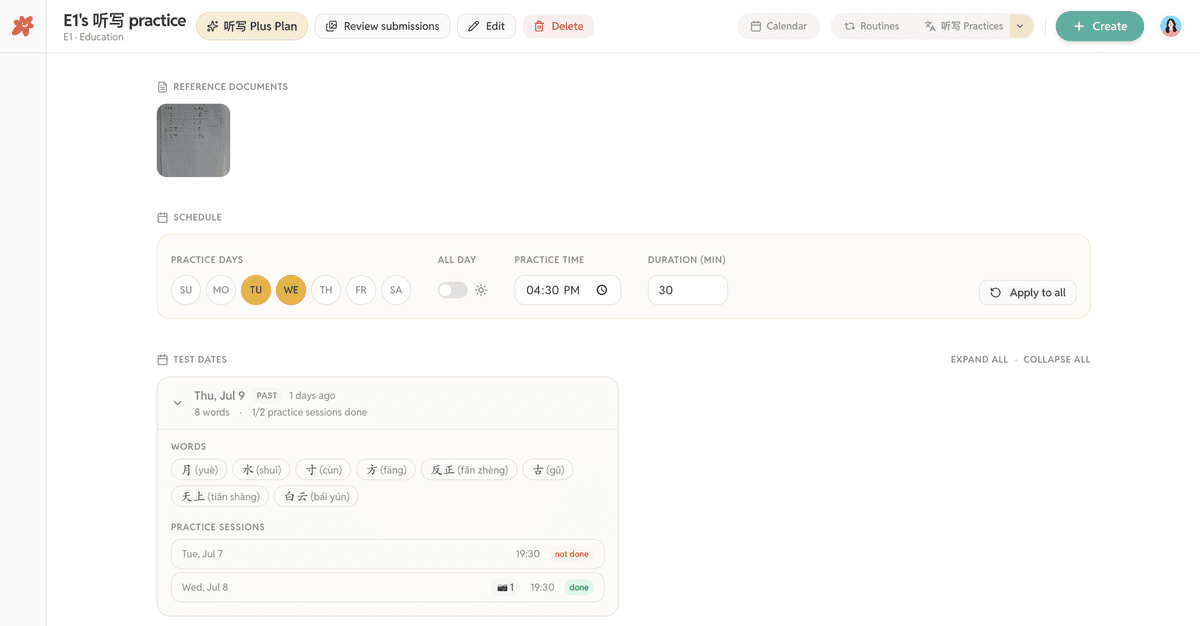
The routine removes the mental load of remembering when and how to practise. Your child knows what to do. The people around them know what to do. And you know it happened, whether you were there or not.
For more details on how to set the routine up and how it actually works, you can watch this video below:
听写 does not have to be the stressful part of your week. With the right tools and a consistent routine, your child goes into the test prepared, and you spend a lot less time feeling guilty about it.
Set up your child's first Chinese Tingxie routine at heytoshi.com
References
[1] Kang, S.H.K. (2016). Spaced Repetition Promotes Efficient and Effective Learning. Policy Insights from the Behavioral and Brain Sciences, 3(1), 12–19. https://journals.sagepub.com/doi/abs/10.1177/2372732215624708
[2] Vlach, H.A., Bredemann, C.A., & Kraft, C. (2019). To mass or space? Young children do not possess adults' incorrect biases about spaced learning. Journal of Experimental Child Psychology, 183, 115–133. https://doi.org/10.1016/j.jecp.2019.02.003