What is 听写 (Ting Xie)? A Guide for Singapore Parents
About the author: Mervyn is a father to three young children, 8, 6 and 3 years old. The eldest is in Primary 2 at a local primary school who does regular 听写 tests every week, and the second eldest has just started having simplified 听写 tests in K2.
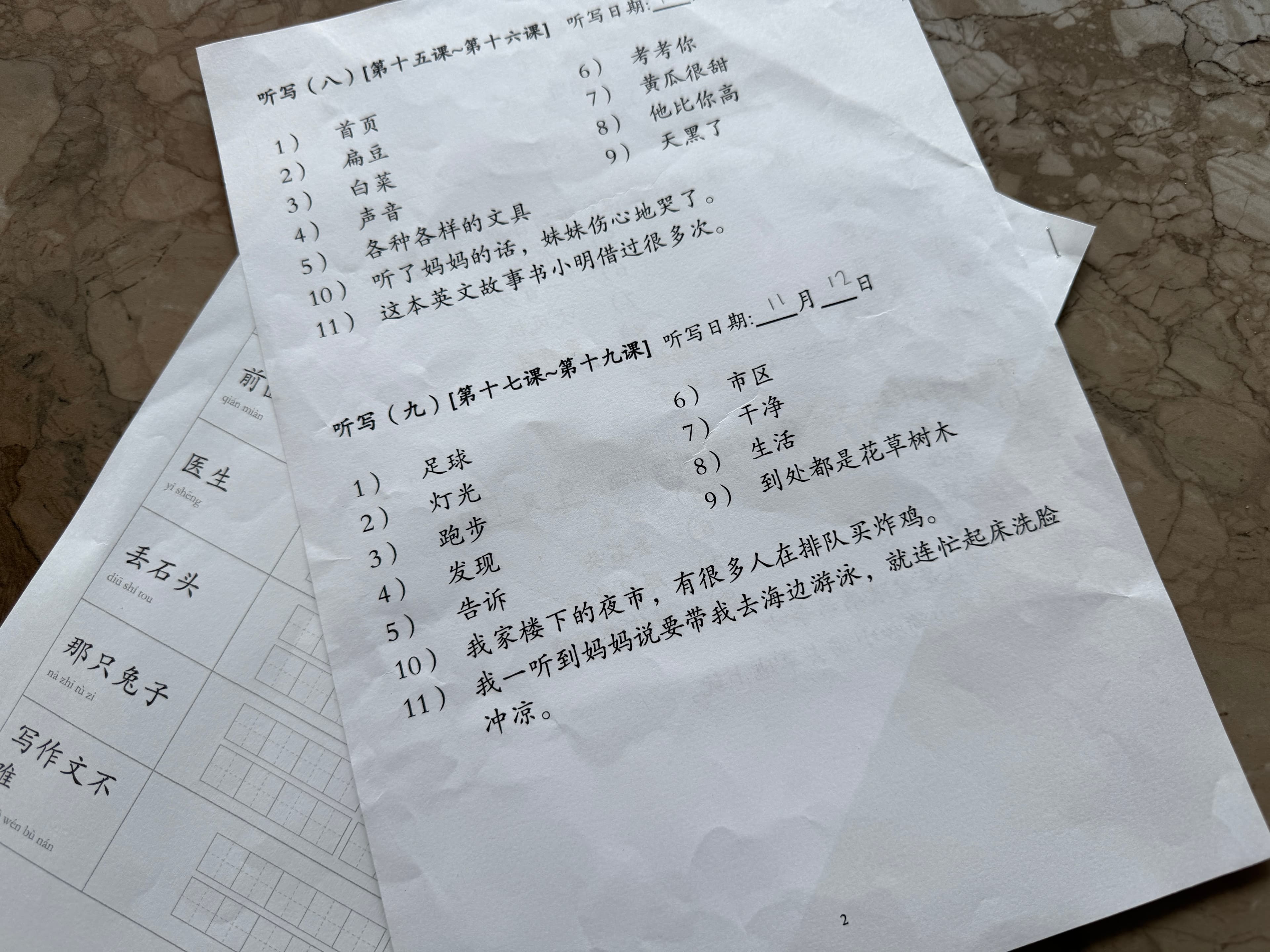
Your child comes home in the second week of January with a slip of paper in their bag. 20 Chinese words. A date. No explanation.
Welcome to 听写.
What is 听写 (ting xie)?
听写, or "ting xie", is the weekly Chinese spelling test taken by students in Singapore primary schools. The teacher reads out a list of words aloud, and the child writes each one from memory in Chinese characters. Most lists contain 15 to 20 terms, are given out about a week in advance, and are tested on the same day each week.
The name is literal. 听 (tīng) means "to listen." 写 (xiě) means "to write." Listen, then write.
You will see it written several ways - 听写, ting xie, tingxie, ting xie - and English-speaking parents often call it "Chinese spelling." They all refer to the same thing.
How is 听写 different from an English spelling test?
This is the question that matters most, and it is the one most parents get wrong at the start. The two tests look similar and are cognitively very different.
English spelling | 听写 | |
|---|---|---|
Building blocks | 26 letters | Thousands of distinct characters |
Can you sound it out? | Usually yes - phonics gives you a route from sound to spelling | No. Nothing about how a character sounds tells you how to write it |
What's being tested | Applying rules and patterns | Visual recall of a specific character |
Homophones | Rare (there, their, they're) | Extremely common - many characters share the same sound and tone |
Does form matter? | No | Yes. Stroke order and proportion are typically marked |
The consequence: your child cannot guess. In an English test, a child who half-remembers "necessary" can produce something close and might land it. In 听写, a half-remembered character is simply wrong. There is no partial route to the answer.
This is why the strategies that work for English spelling - say it out loud, break it into syllables, sound it out - do very little here. 听写 rewards short, frequent exposure over time. Nothing else works nearly as well.
What is actually on a 听写 list?
Lists are drawn from the chapter of the MOE Chinese textbook (欢乐伙伴, Huanle Huoban) the class is currently working through. A typical list contains:
15–20 terms. Note: terms, not characters. Most entries are two-character words (词语) rather than single characters, so a 20-item list can involve 35 or more characters.
Words from the current chapter, usually the ones marked 我会写 ("I can write") in the textbook, as opposed to 我会认 ("I can recognise"), which the child only needs to read.
Increasingly, more than just words. Many schools have expanded the format over the past decade. Depending on the school and level, your child may also be asked to write full sentences (句子), supply the matching 汉语拼音 (hanyu pinyin), or recognise a word used in context rather than in isolation.
If you last sat a 听写 test yourself in the 1990s, that last point is the one to update. The test is broader now than the pure dictation exercise most Singaporean adults remember.
Does 听写 count towards my child's grades?
In Primary 1 and Primary 2, no. Since 2019, MOE has removed all weighted assessments at these levels, including the P2 year-end examination. Anything your child is assessed on in P1 and P2 is non-weighted - it does not contribute to a grade, and report books no longer carry class or level positions.
From Primary 3 onwards, it depends on the school. Some schools fold 听写 results into a weighted assessment component; many treat it as a non-weighted class test used for feedback. Your child's form teacher or the school's parent portal will state which applies.
Here is the more useful way to think about it, and it applies at every level:
The weekly score is close to meaningless. The cumulative vocabulary is not.
A child who sits 30 lists a year at 20 terms each has been walked through roughly 600 words. Whether they scored 18 or 20 on any given Friday is noise. Whether those 600 words are still there in November is the whole game - because that vocabulary is what composition, comprehension, and oral all draw on later.
Parents who optimise for the weekly score tend to cram the night before. It produces a good mark and almost no retention. Parents who optimise for retention practise little and often, accept the occasional 16/20, and end the year far ahead.
听写 vs 默写 — what is the difference?
You may see 默写 (mò xiě) appear later, usually from the upper primary levels.
听写 (ting xie) | 默写 (mo xie) | |
|---|---|---|
Literal meaning | Listen and write | Silent writing |
Prompt given | Teacher reads each word aloud | No prompt at all |
What's tested | Recalling the character from its sound | Reproducing a passage or poem entirely from memory |
Typical level | From Primary 1 | Usually upper primary and secondary |
听写 gives your child the sound and asks for the character. 默写 gives them nothing and asks for everything.
How much practice does 听写 actually need?
Less than most parents think, spread over more days than most parents use.
The research on memory is consistent and it points one direction: short, spaced sessions beat long, massed ones for durable recall. For a 20-term list with roughly a week's notice, a workable pattern is:
Days 1–5: 10 minutes a night, 4 new terms per night
Day 6: 10 minutes reviewing all 20
Day 7 (test day): a 5-minute run-through, nothing new
Total: about an hour, in pieces small enough that a seven-year-old stays engaged. Compare that with a single 60-minute session the night before - the same hour, a similar mark, and dramatically worse retention three weeks later.
The other thing that helps disproportionately: have the child write, not just read. Recognising a character on a page is a much weaker form of memory than producing it on a blank line. Practice should look like the test.
How do I help if I cannot read Chinese?
A large number of Singapore parents are in this position, including plenty of Chinese Singaporeans who grew up speaking English at home. It is a real constraint, not an excuse, and it is more workable than it appears.
The bottleneck is narrower than most parents assume. To run a 听写 practice session, you need exactly three things:
The words, in a usable form. Not a crumpled photo in your camera roll - a list you can actually work from.
Correct audio. Somebody has to read each word aloud, in Mandarin, with the right tone. This is the part you cannot fake, and it is where most parents get stuck.
A way to check the answer. You need to know whether what your child wrote is right.
You do not need to read Chinese for any of this. You need the list converted into something that reads aloud and marks itself. What you contribute is the thing no app provides: showing up for ten minutes a night and keeping it consistent.
A few things worth avoiding:
Don't use text-to-speech that isn't tone-accurate. A wrong tone teaches the wrong word.
Don't let practice become recognition-only. Flashcards where the child says "yes, I know that one" are near-worthless. Make them write it.
Don't skip the pinyin if the school tests it. Many parents drill characters and get blindsided when half the marks turn out to be pinyin.
Toshi's 听写 Practice Routine handles all three. Photograph the list from your child's file and Toshi extracts the words, generates a printable worksheet, and runs a spoken test in Mandarin - reading each term aloud the way the teacher will, then checking what your child wrote. It builds the week's practice into a repeating routine, so 10 minutes a night is scheduled rather than remembered. Try 听写 practice routine.
Common questions
When does 听写 start?
Usually in Term 1 of Primary 1, often a few weeks in once the class has covered its first chapter. Some schools begin with very short lists of five or six terms and build up.
How often is it?
Most commonly weekly. Some schools run it fortnightly, and some alternate 听写 with other Chinese assessments.
My child is in P1 and cannot write characters yet. Is that normal?
Yes. Early P1 lists are short and heavily scaffolded, and stroke formation at that stage is genuinely difficult for small hands. The gap usually closes over the first two terms.
Should I be worried about a bad 听写 score?
A single one, no. A pattern of them across a term is worth raising with the form teacher - but the intervention is almost always more frequent short practice, not more tuition.
Is 听写 the same as Chinese spelling?
Yes. "Chinese spelling" is the everyday English name Singapore parents use for it.
What is 欢乐伙伴?
It is the MOE primary Chinese textbook series used in Singapore schools. Your child's 听写 lists are drawn from whichever chapter the class is currently on.