Three short sessions a week: How my P2 daughter has scored full marks since P1
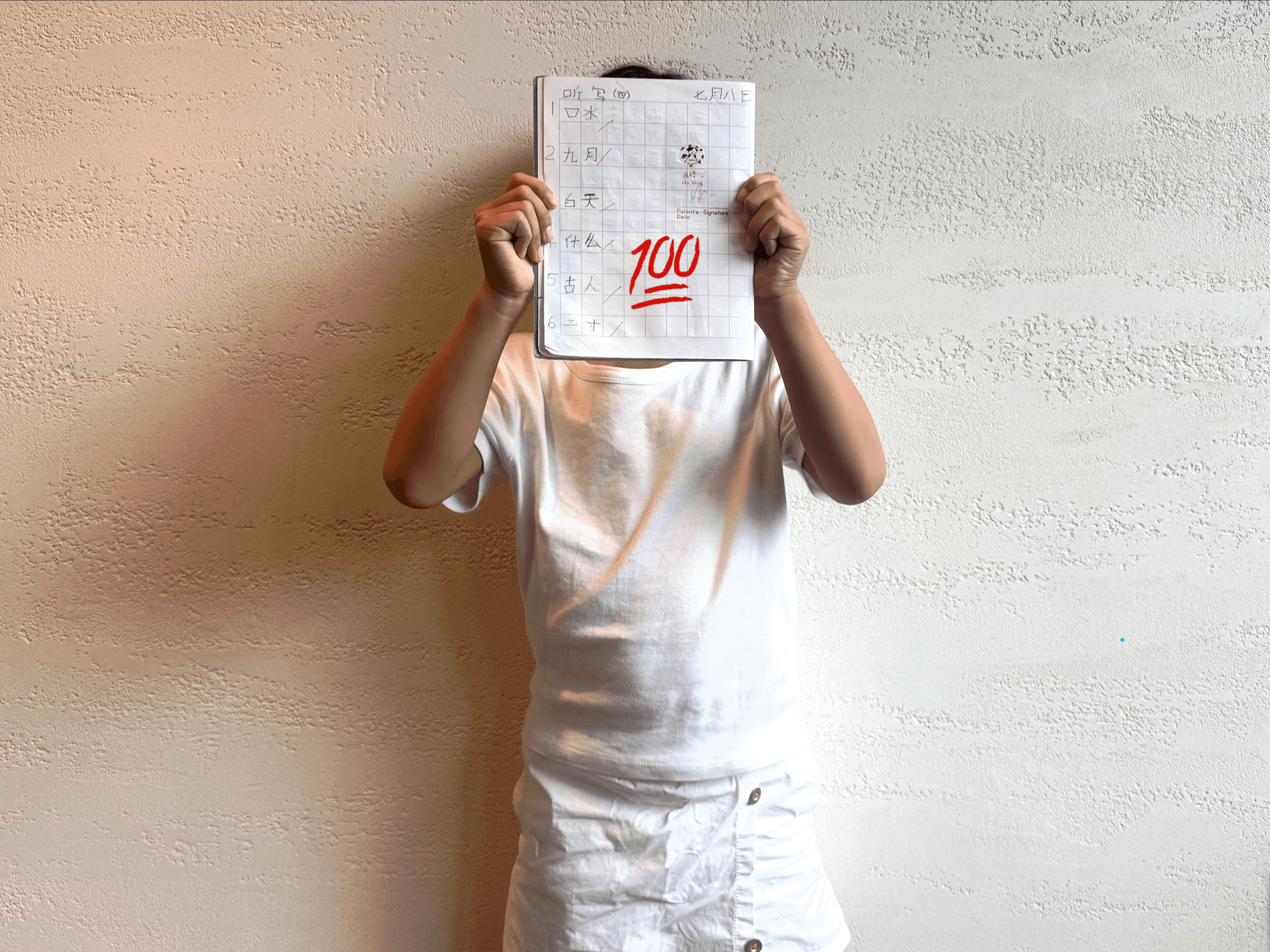
I am a tiger parent. I'm not going to soften that.
When my daughter started Primary 1 and came home with her first spelling list, I did not think "let's see how she gets on." I thought: she is going to get full marks, and it is my job to work out how.
There was no crisis behind this. No disastrous first test, no tears at the table. It was simply the first time in her life she'd been tested on anything, and it seemed obvious to me that someone should teach her how to remember words rather than hope it happened by itself. She struggled at the start — the words genuinely didn't stick — and my response was the least original one available. Practice makes perfect.
So we practised. Three times a week, every week, for two years.
She's in Primary 2 now. She has scored full marks on every English spelling test since P1. Her 听写 (ting xie) record has one blemish: a 9/10, where she wrote the character correctly but not precisely enough on one stroke.
I'm not writing this because the method is clever. I'm writing it because it isn't, and it still worked.
The whole method is consistency
Three sessions, on three separate days, before each test. Ten minutes or so each. Me testing her.
That's it. That's the thing that made the difference. Not a technique, not a tutor, not a clever app — just the same short practice happening three times before every test, without fail, for two years.
I want to be precise about why this matters, because "practise consistently" is the sort of advice that sounds like nothing.
A list of fifteen words spread over three sessions is manageable. The same fifteen words the night before is a crisis. Same list. Same child. Completely different evening. When we tried to do it in one go, she was tired, I was impatient, and by the time we found the words she didn't know it was already too late to do anything about them.
Spread across three days, the whole thing is calm. And crucially, you find out on Monday which words are going to be a problem — which leaves you Tuesday and Thursday to fix them.
What one session actually looks like
She writes the words out first, several times each. Then I test her — I call out each word, she writes it from memory, and we check.
The writing gets the word into her hand. The testing is what tells us whether it stayed there, and that's the part I'd defend hardest.
A child who has read a list over and over will feel completely confident about words she cannot actually produce. Familiarity is not knowledge, and at six or seven there's no way for her to tell the difference on her own. The only way to know is to have someone call the words out with the list out of sight — and then do it again two days later.
Ten minutes. If she's flagging at six, we stop at six. The consistency is doing the work, not the duration.
听写 runs on the same rhythm, with more writing
Same three sessions. Same testing at the end. The difference is how much writing the Chinese needs.
English spelling is partly guessable — a child can often produce a defensible attempt from the sounds. Chinese gives you none of that. A character is either recalled or it isn't, and recall works at the level of individual strokes. My daughter writes her Chinese words out considerably more times than her English ones, which is exactly what Chinese teachers have always meant by 抄写, and it's why the practice has survived.
That one lost mark was this exactly. She knew the word. Anyone would have said she'd written it correctly. She lost the mark on precision, not knowledge — and precision comes from writing, not from looking.
If Chinese is the subject causing the most stress in your house more generally, we've written separately about helping an English-dominant child improve in Chinese (https://heytoshi.com/resources/how-to-help-your-child-improve-in-chinese).
The hard part isn't the method
It's that being the tester means being completely present.
You cannot call out spelling words while half-answering messages. Children detect this instantly, and the session degrades into something that technically happened and achieved nothing. Three evenings a week, I had to actually stop what I was doing — often mid-work — and give it ten minutes of full attention.
Most weeks that's fine, and I still do it myself whenever I can. Being the one who calls out the words is the best ten minutes of the day. But some weeks it simply isn't possible, and those are exactly the weeks the practice slips. Then it's Thursday night and you're cramming, which is the thing the whole system exists to avoid.
That's not a discipline problem. It's a design problem, and it's why we built the Spelling Practice and 听写 Practice Routines on Toshi the way we did.
What we built, and what it's for
The routines exist to do the two things that make consistency hard: the setup, and the evenings you can't be there.
Setup. When the list comes home, you upload it — a photo or a PDF, straight from the school. Then you wait a few seconds. Toshi reads it, extracts every word, works out which words belong to which test and when each test falls, and populates all of it into separate calendar entries automatically. You're not typing out a term of word lists or setting up each test one at a time. You upload once and the term is mapped, which means the three sessions are already scheduled before you've had a chance to forget about them.
For Chinese lists it pulls the hanyu pinyin alongside the characters. If you're not a confident Chinese reader — I'm not — that's the difference between being locked out of the subject and being able to check your child's work.
Each practice session comes with a worksheet: the words laid out with space to write them out.
The testing. On Spelling Practice Plus and 听写 Practice Plus, the audio test reads the words aloud, one at a time, pausing long enough for her to write each one down. The Mandarin readback is accurate — I was sceptical, and I checked.
I want to be clear about what this is for. It is not meant to replace you. If you can sit down and call out the words yourself, do that — it's better, and my daughter and I still do it most weeks. The audio is there for the evenings when you can't, or for parents who'd simply rather not be the one holding the list. On those nights the session still happens, and the finished sheet gets uploaded so there's a record and I go through it with her later.
The sequence is still ours: write the words, sit the test, check the answers, three times a week. It just no longer collapses on the evenings I'm not free.
If you want the step-by-step version of either, we've written them up separately — for English spelling (https://heytoshi.com/resources/how-to-help-your-child-with-spelling-tests-at-home) and for 听写 (https://heytoshi.com/resources/the-best-way-to-help-your-child-practice-tingxie-chinese-spelling-even-if-you-cannot-read-chinese).
The part I didn't plan for
My daughter now asks me to start the test.
She finishes her worksheet and comes to find me. Nobody told her to. She likes getting everything right, she's worked out that this reliably produces that, and so she wants the thing that produces it.
When I ask how a test went, she says it was fine, and often mentions that some of her classmates didn't know half the words. I give her the same answer every time: that's what consistent practice looks like from the outside.
For a child who found these words genuinely hard in P1, that shift — from something imposed on her to something she asks for — is worth more to me than the marks.
Try it for one term
Three sessions. Three separate days. Ten minutes each. You calling out the words. Nothing on the night before the test.
I'm not claiming this is a novel insight, because it isn't. The reason most families don't do it isn't that they don't know — it's that it needs an attentive adult on three specific evenings a week, every week, and that's the thing modern life is worst at supplying.
That's the part we built. The rest is just showing up.
Set up your first practice routine at heytoshi.com
Common questions
How many times a week should my child practise spelling?
Three separate sessions before each test has been enough for us, from P1 through P2. Spreading them across different days matters far more than total time — three short sessions comfortably beat one long one.
How long should each session be?
About ten minutes at lower primary. If your child is flagging at six minutes, stop at six. Frequency is doing the work.
Isn't reading through the list enough?
No, and this is the most common trap. A child who has read a list repeatedly will feel confident about words she can't actually produce. Someone has to call the words out with the list out of sight to find out what she really knows.
Does the same approach work for 听写?
Yes, with the same three-session rhythm. Chinese just needs considerably more writing, because characters are marked on stroke-level accuracy and there's no way to sound them out.
My child wrote the character but still lost the mark. Why?
Almost always stroke accuracy or proportion — a component slightly off, a stroke missing or extra. It's the most common way marks disappear in 听写 even when the child clearly knows the word.
Should I keep old words in rotation from previous weeks?
You can, and there's a case for it. We don't — each week is self-contained, because I wanted something sustainable over six years rather than something that accumulates until it collapses.
What if we miss a session?
Nothing happens. Pick it up the next day. Any system that collapses because you skipped a Wednesday isn't a system.
Is this too much for a P1 child?
Three calm ten-minute sessions across a week is not pressure. One frantic forty-minute session the night before is. In my experience it's the intensity children find distressing, not the frequency.
Toshi turns the recurring parts of family life into routines that run themselves — spelling and 听写 practice, Chinese revision, meal planning and more. See how it works (heytoshi.com)